
Wondering what you see at an actual performance by the Lipizzaner stallions of the Spanish Riding School? Read on for my review and visitor tips…
- Horsemanship of the highest level
- Feels like a special & unique experience
- Enhanced by the historical arena ambience
- Book tickets* for performances & stable tours
- See also:
Craft, strength & elegance

(The Levade move, which I saw at a performance; public domain photo by H. Schuhmann and kindly provided by Sweden’s Helsingborg Museum)
As an Englishman of a certain age, expressions of emotion were drilled out of me soon after birth. But I found myself welling up as the first Lipizzaner entered the arena of the Spanish Riding School.
It’s hard to explain why. I’m horse agnostic, not a royalist, and more Metallica than Mozart.
Yet the combination of background classical music, the emotional weight of over 450 years of history, the baroque ambience, the skill & expertise on display, and, frankly, the extraordinary majesty of the horses, well…pass the tissues.
The performance itself showcased classical horsemanship and felt like a paean to an artistic tradition that goes back to Greek times. As if you might look into a stallion’s eyes and tumble through centuries of history.
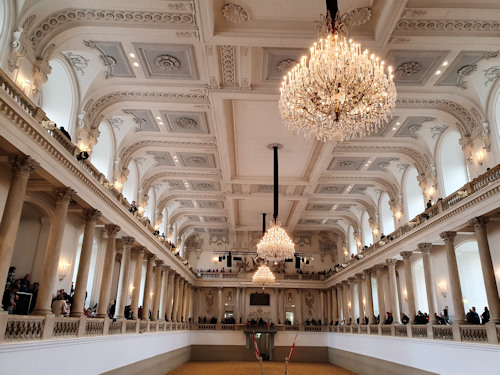
(The baroque arena hosts the performances, though the lighting is very different; photo taken with kind permission of the SRS on a press tour)
I could almost imagine myself next to a count with a moustache you could hang your jacket on, grumbling about barley shortages in the Duchy of Carinthia and the price of wig powder.
The horsemanship on display and seeming telepathy between horse and rider felt so effortless, though only made possible, of course, by many years of training for both stallion and rider.
Watching the Lipizzaner stallions certainly conveyed a sense of privilege at seeing something rather unique and special…a display reflecting a patient dedication rarely found in a world of dopamine-driven doomscrolling.
The stallions themselves exuded that restrained self-assurance of a professional performer. They possessed an imposing grace and majesty enhanced by such names as Neopolitano Mercurio, stylish manes, and equipment you imagine built by people who’d consider any blemish a personal affront.
I even overcame my genetic abhorrence of public displays of approval by ooohing at appropriate moments, as did many other in the audience.
But what did I actually see?
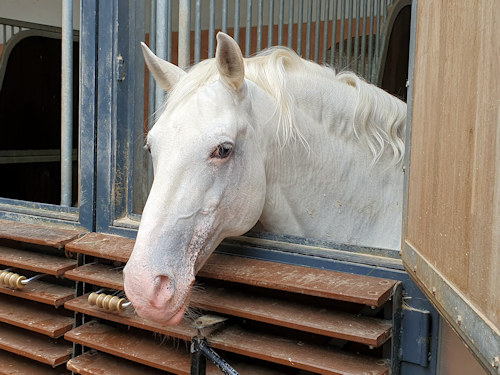
(Fresh from riding down orcs at the Battle of Helm’s Deep. Or possibly not; photo taken on a press tour with the kind permission of the SRS)
At the time of writing, the school has performances of different lengths. My partner and I attended the shortest 45 minute version, and I’d describe the three parts as covering craft, strength and elegance respectively:
- The craft: riderless moves “on the ground” with a single stallion and a rider walking behind using a long rein
- The strength: riderless moves “in the air” with five stallions, which featured the Levade (where a stallion balances on its hind legs) and the Capriole (a stallion leaps into the air and kicks out with its rear legs)
- The elegance: four horses with riders, traversing the arena and displaying a variety of steps and other moves “on the ground”
A moderator offered background information in German and English before each section. All with a restrained reverence that added even more weight to the occasion.
Oh, and all the staff we encountered were very friendly and helpful too!
Tickets & tips
Tickets to performances are available direct from the riding school or from various online agencies. I would definitely recommend booking in advance, given the event’s popularity with visitors.
(Booking service provided by Tiqets.com*, who I am an affiliate of)
A few tips:
- Check your ticket for which entrance you need. I spotted at least three in use, depending on your seats / standing area: one at the main Spanish Riding School visitor centre under the big dome off Michaelerplatz square, one opposite the stables and one on Josefsplatz square
- Should you buy tickets through an agency, you usually need to exchange your voucher for a printed version at that visitor centre off Michaelerplatz: get there a little earlier in case of waiting times at the cash desks
- Get there in plenty of time, anyway. Not just so you can find your way to your seats or standing places without pressure, but also to soak up the subtle lighting and baroque atmosphere
- Standing room tickets are relatively inexpensive compared to seats and have stanchions you can lean on
- Standing room and seats outside the two boxes are around the raised gallery. With the arena sunk into the ground, this means you may temporarily lose some sight of horses passing immediately below you. But you still get to see all the moves one way or another
- We had box seats, which had excellent views…with booster seats available for children
- The arena is enclosed but has no heating. So bear that in mind with your choice of clothes
- The horses get all the deserved attention. But spare some time to focus on the riders now and then to observe the subtleties of control and concentration, not to mention the physical work sometimes required
How to get there
The arena is right in the centre of Vienna within the Hofburg palace complex. See my main article on the Spanish Riding School or use the links to entrance locations above for travel tips. I usually take the U3 subway to Herrengasse.
Address: Michaelerplatz 1, 1010 Vienna (for the main entrance with ticket counters)