
Thanks to JJ’s 2025 win, Vienna hosted the 2026 Eurovision Song Contest. The event took place in the Stadthalle venue. This page had tips and news for those joining us for the fun…
- Vienna hosted for the third time
- Host broadcaster was ORF
- Final was on May 16th, 2026
- Semi-finals on May 12th & 14th
- Book a classical concert* for your trip
- See also:
Jump to:
Where was Eurovision 2026?
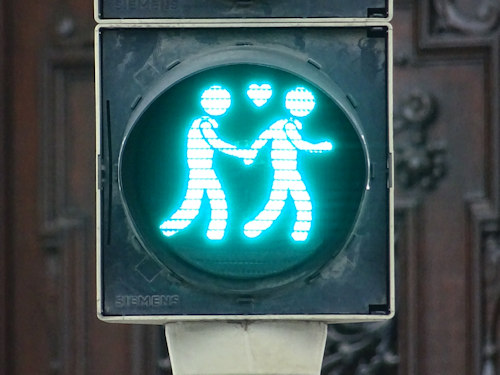
(The pedestrian lights put in the last time Vienna hosted Eurovision)
The domestic broadcaster (ORF) announced on August 20th, 2025 that Vienna would serve as host city for the 2026 Eurovision event.
Vienna was a top choice, of course, given its hotel capacities, airport and transport connections, experience with big events (including previous Eurovision Song Contests), size, and tourist attractions.
The song contest venue was the Stadthalle.
When did it take place?
You could watch the final on Saturday, May 16th, 2026. The semi-finals took place on Tuesday, May 12th and Thursday, May 14th. Each of those events also had preview shows earlier in the day and the evening before, making nine shows in total.
Tips for visitors

(The United by Queerness exhibition covered seven decades of the song contest; press photo © Stadt Wien/Martin Votava)
For example, we had:
- A Eurovision Village with free entry on the large square in front of the neogothic Rathaus city hall: this opened from May 10th to 17th from 2pm to midnight (or whenever the show ended). It opened at 11am on Thursday the 14th. Included live screening of the semi-finals and final, live music, DJs, streetfood, and more
- ORF had a list of public viewing locations across the city (scroll down for “Wien”, which is Vienna’s German name)
- An opening ceremony in the Rathaus with a large stage outside and a turquoise carpet for the entry and presentation of the country delegations. The actual indoor ceremony was shown on large LED screens outside, too
- A United by Queerness exhibition (February 19th to May 24th) at QWien addressed Eurovision in the context of culture, queerness and contemporary history. Included numerous costumes and other objects, photos, audiovisual stations and more
- The Praterdome hosted the EuroClub “party hotspot” across Eurovision week
- Ottakringer brewery was a national partner for the song contest and converted to a Eurovision fanzone on May 15th and 16th
- The Wien Museum coverted to a Eurofan House from May 11th to 16th, 10am to 7pm with a varied programme
- The small Unstoppable! exhibition (March 25th to October 11th) at the House of Austrian History had local contest highlights in the context of Eurovision’s sociopolitical aspects. An accompanying web exhibition took a wider look at the conflicts and political issues that have sometimes affected the competition
- A number of Vienna’s cafés got together to create the Eurofan Cafés with each café representing one or two countries from May 3rd to May 17th. The “UK café” for example was Café Landtmann
Here also some useful articles for those planning a visit to Austria’s capital:
- An introduction to Vienna: with an overview of what it offers and key information on such things as public transport
- Where to stay: a collection of articles with accommodation suggestions and related tips
- Events in May: overview of fairs, festivals and other significant events of interest to visitors
- What to do in the evening: ideas beyond simply enjoying dinner or a drink

(Vienna has excellent airport connections for those arriving from abroad)
Vienna and Eurovision
JJ’s win was the third victory for Austria in the song contest. On both previous occasions, Vienna hosted the event the following year.
Merci, Chérie
The song Merci, Chérie brought Udo Jürgens victory in the 1966 contest held in Luxembourg. The 1967 event took place in the rather glorious imperial surrounds of the Hofburg palace with the UK winning (Sandy Shaw’s legendary Puppet on a String).
You can wander around the Hofburg and look inside via the Sisi Museum & imperial apartments. But the Festsaal location used for the song contest is not normally accessible to the public outside of special events and some concerts*.
Jürgens had a hugely successful singing and writing career in Austria. He passed away in 2014 and is buried in a lovely grave in Vienna’s Zentralfriedhof cemetery.
Rise like a Phoenix
Conchita Wurst won Eurovision with Rise Like A Phoenix in the 2014 event held in Copenhagen, Denmark. The dress they wore for the final is on display in Vienna’s House of Austrian History.
The 2015 song contest (the 60th edition) then took place in the Stadthalle with Sweden winning (Måns Zermelöw’s Heroes).
That event left a rather nice mark on the city.
To celebrate the occasion, the authorities installed temporary couples pedestrian lights in both same sex and mixed sex constellations at numerous junctions. However, they proved so popular that they’ve stayed.
And a good thing, too, given Eurovision’s return in 2026…