
Discover the cultural icon, nature park, recreational resource, and hydrological masterpiece that is the Donauinsel (Danube Island).
- Hosted at the Wien Museum on Karlsplatz
- Highlights the history and context of the island
- …and its multiple roles in today’s Vienna
- Runs Mar 26 – Aug 30, 2026
- See also:
13 Miles of Freedom
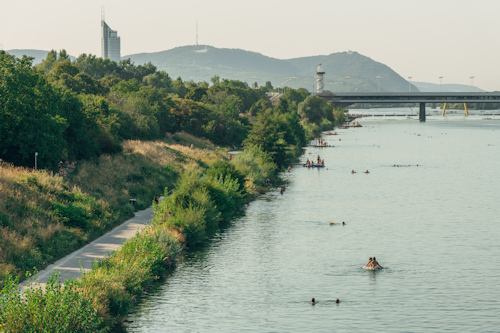
(More than just flood control; press photo © Klaus Pichler)
Pull out words associated with Vienna, and beaches or beavers probably don’t make the top 10. Yet the city has both, not least on the Donauinsel (Danube Island).
At this point, you’re likely picturing some patch of rocky woodland surviving in the middle of the famous river by virtue of geological accident.
The Donauinsel, however, actually runs for over 20km with a width of up to 300m. It effectively splits the giant river into two halves where it passes through Vienna.
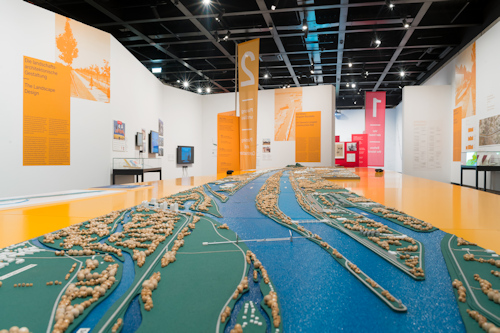
(View of the exhibition; press photo © Klaus Pichler)
The city authorities built the island across the1970s and 1980s as a much-needed flood control measure, albeit a controversial one given the cost.
Should your eyes glaze over at the term “flood-control measure”, then you might want to visit the Donauinsel exhibition at the Wien Museum on Karlsplatz.
The Donauinsel in 2026 is, for example, a nature reserve and naturist refuge, an environmental resource and recreational hotspot, a home to bars and beavers, festivals and fireflies. And it occupies a special spot in the identity of the city.
The exhibition traces the Donauinsel’s journey from a hydrological project to today’s multifunctional cultural icon.
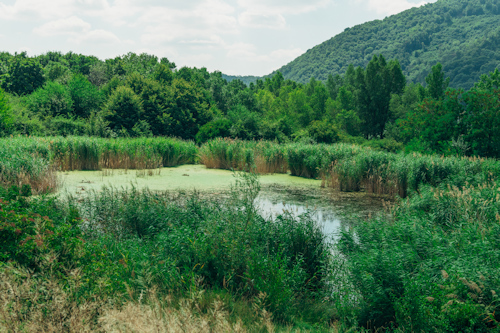
(The island has considerable value as an environmental resources; press photo © Klaus Pichler)
And much like the Danube itself, the exhibition branches off now and then to slip through related areas. For example:
- The island’s ecological, social and cultural roles in a city of two million. Roles as diverse as the population itself. You might find Pakistani students playing cricket on the island, a Thai community picnic, street artists and fishermen
- The planning and construction challenges of such a mammoth project as well as the arguments preceding its commission. An original 30-foot 1979 display model brings home the scale of the undertaking
- The floods and capricious nature of the river that made such drastic protection measures necessary. Projections of the course of the river through the centuries make it clear why a church built on the river shore is some distance from water today
Rather neatly, the exhibition ends with highlights from an Instagram photo competition themed on the island. The diversity of images pays suitable tribute to the multifunctional theme running through the preceding sections.
Dates, tickets & tips
Explore the Donauinsel from March 26th to August 30th, 2026. Admission to the permanent display of the Wien Museum is free, but special exhibitions like this require the purchase of a ticket.
You can also, of course, visit and walk around the island itself. When in Vienna’s centre, catch the U1 subway to the Donauinsel station from, for example, Stephansplatz or Karlsplatz. Or take the U6 subway to the Handelskai or Neue Donau stations. More details are in my article on the island.
And, if you’re in the Wien Museum, then consider another ticketed exhibition on across much of the same time: Schiele & Peschka (April 30th to September 27th, 2026), which offers biographical and artistic insights into the former courtesy of the estate of the latter.
How to get to the exhibition
You can follow the travel tips on my main Wien Museum page, but the museum is on central Karlsplatz square. This has its own large, same-named subway station (on the U1, U2 and U4 lines) and a major tram station (Oper/Karlsplatz on the D, 1, 2, 71 and 62 lines and opposite the State Opera House).
Address: Karlsplatz 8, 1040 Vienna