Deepen your understanding of the art and genius of Egon Schiele with this small exhibition around two artist families.
- Draws on the Peschka Collection
- Includes original Schiele art
- Adds context to the artist life
- A feast for Schiele fans
- Runs April 30 – Sept 27, 2026
- See also:
Art & biography
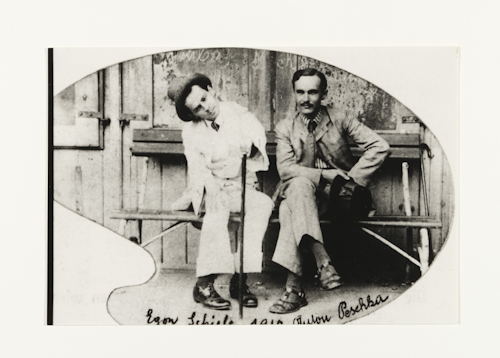
(Erwin Dominik Osen (?), Egon Schiele and Anton Peschka in Krumau, 1910; photo: Wien Museum c. private archive)
We tend to see great artists as entirely separate from the banalities of life. As if they exist outside of time and space.
Yet their daily life and family context tells us much about the art of those same individuals.
A recent exhibition at the Leopold Museum, for example, showed clearly how World War I impacted Egon Schiele’s output and style.
The Wien Museum delivers a similar experience with Schiele & Peschka.
Whereby this small exhibition covers a wider remit: we see art, gain insights into art history and family life in the tumultuous times of the early 20th century, and enjoy an indirect peek behind the curtains of artistic creativity, motivation, and inspiration.
All of this is made possible through the Peschka Collection: Anton Peschka jun. left his estate to the city of Vienna in 1997.
The significance of that bequest comes from the family history. Anton Peschka jun.’s father was an artist and friend of Schiele. More than a friend…he married Schiele’s sister Gerti in 1914.
So that estate contains a wealth of photos, documents, furniture, household items, and works of art that offer a snapshot of creative life in the Vienna of the time with many intimate connections to Schiele himself. These now provide the basis for the exhibition.

(Egon Schiele, Young Mother, 1914. Photo: Birgit and Peter Kainz, Wien Museum)
We see, for example, several works of art by Schiele, such as 1918’s Mödling II, 1910’s The Scornful Woman, and 1914’s Young Mother.
Further estate material and museal research enhances enjoyment of such works. For example:
- Schiele’s charcoal drawing of Gustav Klimt in the morgue hangs next to a postcard from Gertie to her husband lamenting that very same death
- An earlier draft of Young Mother featured a second child, whose outline you can still see despite being painted over in the final version (look up and right from the middle of the picture)
Schiele gifted Young Mother to his sister after her first child and while she expected a second. Perhaps he decided not to tempt fate in times when childbirth carried its own dangers?
While the chance to view Schiele’s brilliance on paper and canvass is justification enough for a visit, the other displays address those intriguing contexts mentioned earlier.
So, for example, we get a look at Anton Peschka’s own paintings with some clear Schiele influences: most notably in 1920’s Krumau Cityscape.
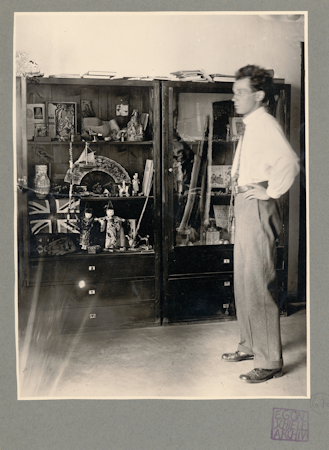
(Johannes Fischer, Egon Schiele with his collection, 1915/1916, ALBERTINA, Vienna; image: ALBERTINA, Vienna)
And we also see Schiele’s glass display cabinet with his collection of items and oddments. Quite apart from the direct link to an artistic great, the curiosities within have you wondering what lay behind their acquisition: sources of inspiration? Reminders of some experience? Or just trivial souvenirs?
A photo of Schiele in front of that same cabinet reveals the authenticity of the items within. Sadly, though, the union jack seems to have gone missing sometime in decades past. What story might it have told?
We also learn, for example, of Peschka’s efforts to dispose of the art in Schiele’s own estate, where the former’s “enhancements” proved financially necessary in troubled economic times but might raise the eyebrows of art historians and purists.
As well as items on display, digital stations give you access to photos, sketches and more to allow further exploration of the themes covered by the exhibition.
The combination of art and context makes this a true treasure trove for Schiele fans and those who like a deeper dive into artistic life and history.
Dates, tickets & tips
Enjoy the Peschka Collection items and what they tell us about Egon Schiele from April 30th to September 27th, 2026.
Although the permanent exhibition of the Wien Museum on Karlsplatz is free, the special exhibitions require a ticket. Buy one online or at the cashdesk on the museum’s ground floor.
That permanent exhibition has more art by Schiele to view, and two further museums in Vienna have notable public Schiele collections: Belvedere and the Leopold Museum.
For other suggestions on how to follow in Schiele’s biographical footsteps or see his paintings and drawings, check out my full guide to Schiele in Vienna.
How to get there
You can get travel tips from my main Wien Museum article. But the museum occupies one end of the park outside Karlsplatz station, which is a stop on the U1, U2 and U4 subway lines. Look for the Resselpark exit on the eastern side of the station.
The exhibition is on the 4th floor, adjacent to the special exhibition on the Danube Island that runs for much of the same period (until August 30th, 2026)
Address: Karlsplatz 8, 1040 Vienna