Belvedere is famous for the gardens connecting the upper and lower palaces: sculpted hedges and cascading waters that scream “Baroque prince with money to spare”.
But the west wing of Lower Belvedere and the Orangery offer access to another garden: the Kammergarten (privy garden).
- Part of the Lower Belvedere complex
- Small Baroque garden with no crowds
- Great for an 18th-century feeling and views of the Orangerie
- Sometimes hosts open-air cinema
- Book Lower Belvedere tickets* online
- See also:
The privy garden
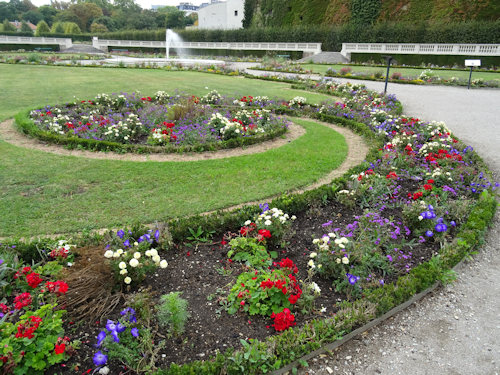
(The Privy Garden one October)
The Kammergarten consists of a long, private garden hidden away behind high walls, hedges and decorative gates.
The aviaries, pavilions and pergolas that provided private amusement for Prince Eugene and honored guests are largely gone. But you might still pop in for three particular reasons.
First, few people visiting Belvedere find their way to the Kammergarten, so you can gain a little respite from the crowds if it’s a busy time of year.
I once found myself there entirely on my own on a Saturday morning in July.
Second, the Bundesgärten federal gardens agency and visiting artists do a grand job of maintaining the garden, often in the form of an outdoor exhibition.
For example, summer 2023 featured the flowers of Gustav Klimt.
A lot does depend on the timing of your visit. I’ve been there in late May and seen only empty flower beds; by mid-June those same beds had become a riot of colour.
If you’re in luck, then, the gardens form a flower and shrub-filled delight with the odd fountain or two gurgling along for good measure.

(View from the Kammergarten across to the Salesian church)
Finally, your third reason for visiting…
Find your way right to the very back and the former location of a Baroque aviary. You should come across a secluded area hemmed in by tall hedges. Stand in the right place when the foliage is out, and all you can see around you are:
- To the west, the tops of the trees in the grounds of the neighboring Palais Schwarzenberg (the plans for these gardens date back to 1697)
- To the east, the large dome of the Salesian church and convent (completed in 1719)
You’re back in the 18th century.
All you require to become a member of the Baroque nobility is a decent wig, some uncomfortable clothes, and a few servants to oppress.
Ticket and visitor tips
Any ticket valid for Lower Belvedere includes entry to the Kammergarten. (The main Belvedere gardens are free to visit).
(Booking service provided by Tiqets.com*, who I am an affiliate of)
A fourth reason for visiting the privy garden exists, too, but usually only in August. That’s when Kino im Kammergarten may take place: daily open-air cinema in the late evening. (The event has taken a break in recent years, though.)
Outdoor cinema has its own fascination, of course, but more so when that “open air” is flowing past historical gardens and early 18th-century palaces.
Incidentally, the city apparently once intended leasing the Kammergarten to the composer Richard Strauss, but he chose instead to build a villa on the other side of the botanic gardens. His loss. Our gain.
Finding the Kammergarten
See the directions for the lower palace. Enter from the west wing, for example through the glass doors next to the orangery.
Address: Rennweg 6, 1030 Vienna