The Ring Tower (Ringturm) packs a few surprises for passers by. Although an office block, it also doubles as an exhibition space, weather indicator, and work of art.
- Opened in 1955
- Home to the Wiener Städtische insurance company
- Façade often covered in art or a light display
- Book a two-hour walking tour* in Vienna
- See also:
A building & symbol
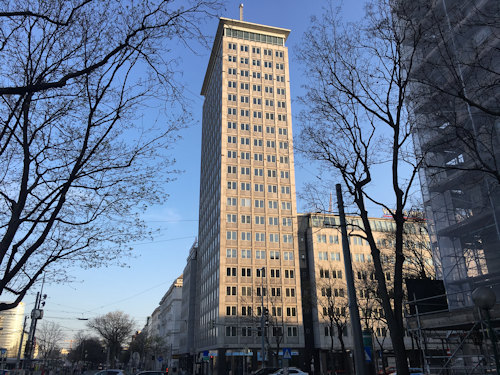
(One of Vienna’s first tower buildings)
At 73m high, with the light mast reaching up another 20m, the Ringturm is the second-highest building in Vienna’s old town; the highest is Stephansdom cathedral.
This was the first office tower of its kind in Vienna, joining the skyline in 1955 after a two-year building period. The construction date explains the absence of pan pipe-wielding satyrs and similar motifs of imperial Vienna.
Built on the Ring boulevard to house the new headquarters of the Wiener Städtische insurance company (a job it continues to do), the Ringturm also played a symbolic role in the emergence of Vienna from the long shadow of WWII.
For example, the 23-floor construction replaced one of the buildings destroyed by allied bombing. And 1955 was also the year Austria gained its independence from allied occupation.
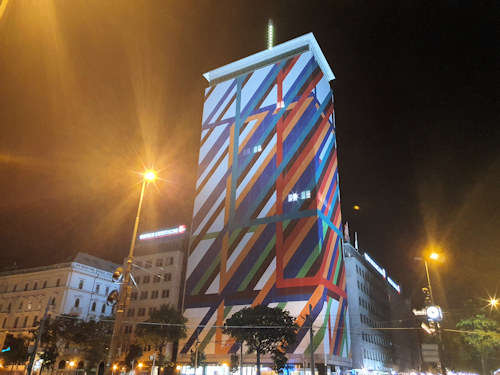
(The Ringturm in summer 2022 with the installation by Dóra Maurer)
Equally, US skyscrapers (with all their economic and political symbolism) inspired the architectural approach; the insurance company CEO had spent time in US exile.
The building remains one of the few architectural highlights from that era that have managed to establish themselves among all the other stars of the historical cityscape.
But the Ringturm and its insurance company owners offer more than just evidence of Austria’s post-war renaissance…
Art and architecture
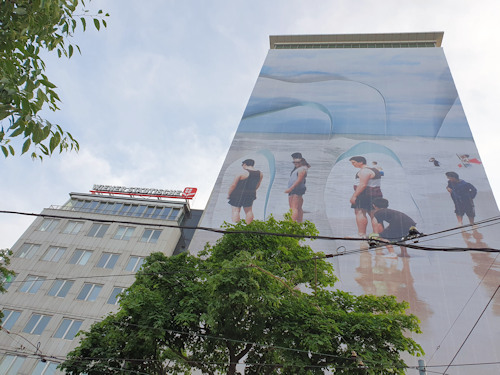
(The Ringturm in summer 2023 with art by Vanja Bućan)
The entrance to the tower, for example, provides a home for Architektur im Ringturm: free exhibitions typically showcasing architecture from Austria and nearby central and eastern Europe.
Every year also usually sees a few months with the building’s façade covered with printed sheets to form a giant work of art.
Artists of international distinction have contributed designs, including Gottfried Helnwein, Arnulf Rainer, Xenia Hausner, and Christian Ludwig Attersee.

(Art in 2024 by Johanna Kandl; photo © Stadt Wien / Christian Jobst)
Summer 2023, for example, saw Slovenian artist Vanja Bućan create an apparently idyllic seaside scene, but the background to Wandernde Eisberge (my translation: wandering icebergs) hinted at the climate emergency.
In 2024, Austrian artist Johanna Kandl offered us a 4000m2 collection of colourful storage objects labelled in different languages. The words represented intangible qualities like courage.

(An early morning shot of Marcin Maciejowski’s 2025 work)
2025 had Marcin Maciejowski’s Verbindinde Geschichten (my translation: connecting stories) turn the Ringturm façade into a peek into a home library.
The summer 2006 edition features Your Happiness is in Your Own Hands by Moldavian artist Pavel Brăila. Ostensibly a step-by-step visual guide to preparing the traditional sarmale dish, it reflects (cultural) practices that help retain that connection to home, wherever you may be.
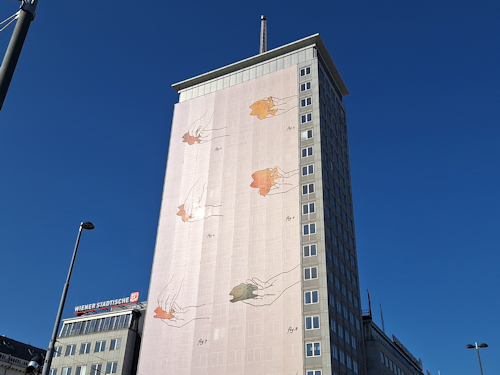
(Pavel Brăila’s contribution to the tower’s 2026 summer art)
Christmas decoration
That same façade turns into a mammoth Christmas tree in December, with falling snowflakes completing the display. It’s a traditional element in Vienna’s Christmas lights.
In the 2025 Advent period, for example, the lights went on each day from 6am to 8am and from 4pm to 11pm.
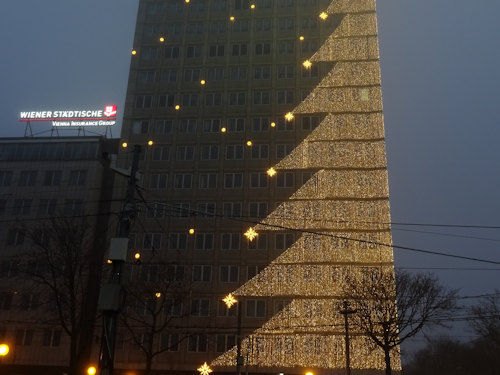
(A relatively common sight during Advent)
Oh, and one more thing…
Weather indicator
The light mast at the top of the Ringturm hooks up to Vienna’s main meteorological station. The display – featuring over 100 lights – changes colour and direction according to the prevailing weather forecast.
So, for example, descending red lights indicate it’s getting colder and blinking white lights are a snow/ice warning. If the lights blink red, then take cover: a storm is on its way.
How to get to the Ringturm
The tower sits opposite the Schottenring station, which is on the U2 and U4 subway lines, the 1 or 31 tram lines, and bus line 3A. A short walk from the very centre will also get you there.
An even shorter walk past the Ringturm away from the centre brings you to an arm of the Danube. The Donaukanal comes alive in summer with open-air bars and restaurants, and makes its own contribution to the Viennese art scene through the ever-changing street art along its banks.
Address: Schottenring 30, 1010 Vienna