
If there’s one food most closely associated with Vienna, then it’s the Wiener Schnitzel.
- Vegetarians and vegans look away (I’m one, too)
- Fried, breaded escalopes typically made of pork, veal, turkey or chicken
- Side dishes in restaurants can be more or less just decoration: it’s all about the meat
- See also:
So what is a Wiener Schnitzel?
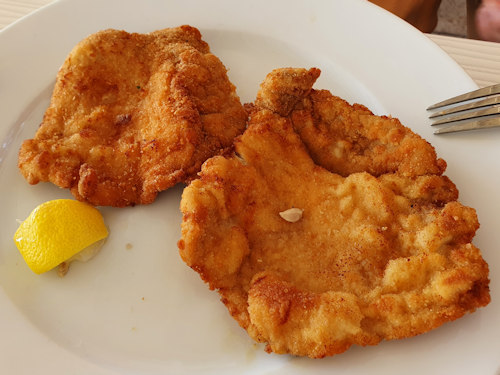
(Homemade Schnitzel)
Traditionally, a Wiener Schnitzel is a cutlet of veal pounded thin by a meat tenderizer, then dipped in flour, egg and breadcrumbs (in that order), and fried until golden.
Wiener means “Viennese” in German, but the concept behind the Wiener Schnitzel likely first appeared elsewhere (I’ve read in Milan, Italy). Just don’t tell the Viennese that.
The dish is not one of those traditions only found in tourism brochures. It really is a hugely popular meal in Austrian homes, though most families use pork rather than veal (see later).
So, if you’re OK with eating meat, having a Wiener Schnitzel certainly counts toward your collection of authentic Viennese experiences.
This popularity becomes evident when you enter any restaurant. You find Schnitzel on just about every single menu in the city (which makes it perfect for comparing prices across establishments).
Some locations, such as Figlmüller, might consider the dish as their raison d’être. And even places specialising in foreign cuisine may still offer Schnitzel as an option.
With time, various derivatives of the basic format have appeared.
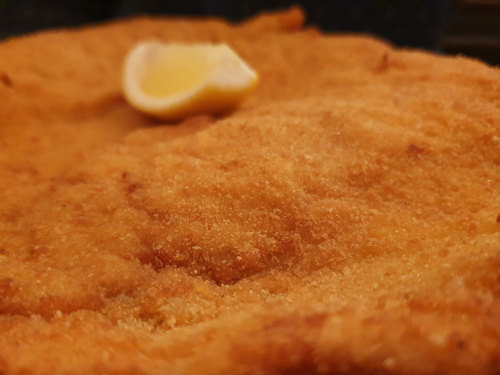
(If you’re looking for the side salad, it’s the piece of lemon)
The most popular alternative is probably the Cordon Bleu, which takes the basic Schnitzel and adds a filling of melted cheese and chopped ham. You also find Naturschnitzel on menus, which is a cutlet without the coating.
The dish even has its own snack version: the Schnitzelsemmel is a Schnitzel roll and exactly as it sounds: a bread roll with a piece of Schnitzel as filling.
Pork or veal?
If a restaurant sells Schnitzel made from some other meat than veal, then they have to say so. In other words, assume your Schnitzel is veal if not otherwise labelled in the menu.
You’ll soon discover that veal is actually relatively rare in restaurants, not least because of the expense.
Most places have the pork (Wiener Schnitzel vom Schwein) version instead. The menu might also feature a turkey (Putenschnitzel) or chicken (Huhnerschnitzel) option, too.
As for what else comes with your Schnitzel, well, good luck with that. Most restaurants definitely give you a slice of lemon to squeeze over the dish.
And that’s about it. I’m (almost) serious.
Don’t be surprised to get a near pizza-sized piece of meat deposited on your plate with a sprig of parsley as a garnish. (On a serious note, do check what your Schnitzel comes with: you may need to order side dishes extra.)